
When mammalian tissue suffers ischemic, mechanical, or chemical trauma, the subsequent biological response requires a massive, perfectly coordinated migration of repair cells to the site of injury. This localized cellular recruitment does not happen autonomously; it is governed by a highly complex network of peptide signaling gradients. At the absolute center of this regenerative cascade is Thymosin Beta-4 (Tβ4), and its widely researched synthetic analog, TB-500.
While early endocrinology initially classified Thymosin β4 as a restricted thymic hormone, modern molecular biology has radically redefined it. It is now recognized as a ubiquitous, fundamentally critical intracellular polypeptide. Present in extremely high concentrations in blood platelets, macrophages, and virtually all nucleated human and animal cells, Tβ4 operates as the primary actin-sequestering molecule in eukaryotic organisms.
To understand how TB-500 functions as a highly potent regenerative research compound, we must bypass the superficial consumer claims of "rapid healing" and look directly at the cellular architecture. The true efficacy of TB-500 lies in its unique ability to hijack and optimize the cellular cytoskeleton, forcing cells to become highly mobile, initiating targeted angiogenesis, and actively suppressing fibrotic scar tissue formation.
The Biochemical Identity of TB-500
Thymosin β4 is a naturally occurring, highly water-soluble, 43-amino-acid peptide with a molecular weight of approximately 4.9 kDa. Due to its exceptionally low molecular weight and lack of binding to the extracellular matrix, it is highly mobile. It can diffuse rapidly through tissue layers and the systemic vascular network, crossing barriers that block larger, heavier proteins.
TB-500 is the synthetic laboratory equivalent, designed to mimic the exact physiological actions of endogenous Tβ4. In specific pharmacological research contexts, "TB-500" often refers specifically to the isolated active sequence fragments of Tβ4 that strictly retain the actin-binding properties without the ancillary cellular functions.
Unlike localized growth factors—such as localized vascular endothelial growth factor (VEGF) or even certain applications of BPC-157—which only operate effectively at the direct site of injection, TB-500 exerts a systemic effect. When introduced into a biological system, it actively navigates toward systemic sites of inflammation. This targeted homing mechanism is intrinsically linked to the peptide's primary biochemical directive: the spatial and temporal regulation of cellular actin.
Actin Dynamics: The Cytoskeletal Engine
To comprehend the mechanics of cellular migration, one must first deeply understand actin. Actin is the most abundant protein in the majority of eukaryotic cells, forming the microfilaments of the internal cytoskeleton. It exists in a state of constant flux between two distinct forms:
G-actin (Globular actin): Free-floating, individual, unlinked monomeric protein units.
F-actin (Filamentous actin): Long, rigid structural polymer chains formed when G-actin monomers link together in a spiral matrix.
A living cell is not a static biological balloon; it is a highly dynamic structure built upon a shifting scaffolding of F-actin. When a cell needs to move, divide, or change its physical morphology, it must rapidly deconstruct existing F-actin filaments at the rear of the cell and build new ones at the front, pointing in the direction it intends to travel. This process requires an enormous reserve of free G-actin monomers in the cytoplasm, ready to be deployed instantly.
However, G-actin is inherently unstable in isolation; it naturally wants to polymerize into F-actin. If left completely unregulated, a cell's cytoplasm would quickly solidify into a rigid, paralyzed web of filaments. This is the exact biochemical intersection where TB-500 demonstrates its primary mechanism of action.
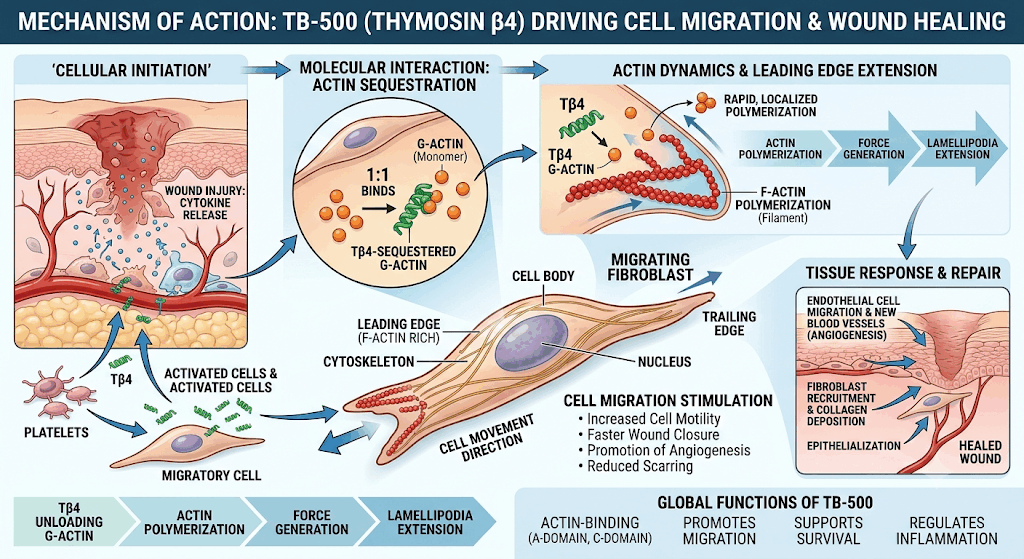
TB-500 acts as an intracellular biological buffer. It binds to individual G-actin monomers in a strict 1:1 complex, effectively "sequestering" them and preventing them from polymerizing prematurely. Because Tβ4 is maintained at such profuse concentrations in the cytosol, it sustains a massive, liquid pool of unpolymerized G-actin. When a chemotactic signal (such as inflammatory cytokines from a nearby injury) triggers the cell to move, TB-500 releases the sequestered G-actin precisely where it is needed at the cellular membrane, allowing for rapid, localized, and explosive filament growth.
Mechanics of Cell Migration: How Cells "Crawl"
Cell migration is the fundamental prerequisite for tissue regeneration and wound healing. Stem cells, fibroblasts, immune macrophages, and endothelial cells must physically travel from their origin points or the bloodstream directly into the damaged tissue bed. TB-500 facilitates this locomotion through a biomechanical process that allows cells to literally "crawl" across the extracellular matrix (ECM).
When a cell detects an injury gradient, TB-500 unloads its payload of G-actin at the cell's leading edge. The rapid, uncontrolled polymerization of F-actin physically pushes the cellular membrane outward. This creates flat, sheet-like forward protrusions known as lamellipodia, or highly focused, sharp, spike-like extensions called filopodia.
This cellular migration cycle operates in a continuous, four-step mechanical engine:
Extension: TB-500 releases G-actin at the leading edge. Rapid polymerization creates force, pushing the lamellipodia forward into new territory.
Adhesion: The newly extended front membrane grips the underlying extracellular matrix via specialized transmembrane proteins called integrins.
Translocation: Myosin motor proteins contract the internal cytoskeleton of the cell body, pulling the heavy nucleus and internal organelles forward to catch up with the leading edge.
De-adhesion: The rear of the cell detaches from the ECM, and old F-actin filaments at the trailing edge are disassembled back into G-actin, ready to be re-sequestered by TB-500.
By meticulously maintaining the delicate equilibrium between G-actin and F-actin, TB-500 ensures that this "treadmilling" effect of actin filaments operates at absolute peak efficiency. In in vitro laboratory assays, environments enriched with Thymosin β4 consistently demonstrate an exponential, dose-dependent increase in both the velocity and the survival viability of migrating progenitor cells compared to control environments.
Angiogenesis: Constructing the Vascular Supply Network
Without a dedicated blood supply, regenerating tissue undergoes necrosis. A critical limiting factor in severe wound healing, myocardial infarction (heart attack) recovery, and massive muscle tear regeneration is ischemia—the localized lack of blood flow and oxygen. TB-500 serves as a highly potent angiogenic factor, directly stimulating the creation of new blood vessels from pre-existing local vasculature.
The mechanism of TB-500-induced angiogenesis is intrinsically tied to its actin-regulating properties, but it acts with extreme specificity upon endothelial cells (the specialized cells that line the interior walls of blood vessels).
Advanced peptide research utilizing proteolytic fragments has successfully isolated a specific seven-amino-acid actin-binding motif within the broader TB-500 sequence that is absolutely essential for this angiogenic activity. When TB-500 interacts with local endothelial cells near a wound site, it triggers a morphological transformation. The endothelial cells detach from their stable, flat state in the capillary wall, migrate toward the hypoxic (low oxygen) tissue, and begin to tightly adhere to one another to form three-dimensional tubular structures.
In rigorous in vitro models, such as chick aortic arch sprouting assays and human umbilical vein endothelial cell (HUVEC) migration tests, the introduction of the TB-500 peptide (specifically maintaining the actin-binding motif) results in pronounced aortic ring sprouting and rapid capillary tubule formation. By vastly accelerating the construction of these microvascular networks, TB-500 ensures that oxygen, systemic nutrients, and secondary repair cells are actively pumped into the damaged zone, thereby drastically condensing the regenerative timeline.
Wound Healing, Inflammation, and Fibrosis Mitigation
Beyond cellular locomotion and vascularization, TB-500 plays a crucial, protective regulatory role in the late stages of tissue repair—specifically regarding the mitigation of fibrosis, commonly known as scar tissue.
Following severe trauma, such as full-thickness dermal wounds, surgical incisions, or ligament ruptures, the mammalian body often defaults to a disorganized, emergency repair protocol. Fibroblasts rush to the site and haphazardly lay down dense, cross-linked collagen networks. While this effectively seals the wound and prevents infection, it results in structurally weak, inflexible scar tissue that can severely impede joint mobility, limit muscle contractility, and cause chronic nerve pain.
TB-500 actively alters this trajectory. Upon arriving at the wound site—often delivered natively by aggregating platelets or via exogenous injection—it performs several simultaneous regulatory functions:
Cytokine Modulation: TB-500 downregulates the expression of aggressive pro-inflammatory cytokines, preventing the chronic, destructive inflammation that often leads to necrotic tissue expansion.
Apoptosis Reduction: It actively protects surviving cells in the ischemic penumbra (the area immediately surrounding the primary injury) from apoptosis (programmed cell death), thereby preserving existing healthy tissue architecture.
Myofibroblast Regulation: Most crucially, TB-500 decreases the local concentration of myofibroblasts in the later stages of the healing cascade. Myofibroblasts are the primary contractile cells responsible for harsh wound contraction and dense scar formation. By suppressing their overactivity, TB-500 promotes a highly organized, linear, and native deposition of collagen.
The clinical result—demonstrated extensively in foundational 1999 rat full-thickness wound models and validated in subsequent modern human corneal repair trials (such as RGN-259)—is a wound that closes at an accelerated rate, exhibits vastly superior biomechanical tensile strength, and leaves a minimal fibrotic footprint.
Conclusion: A Systemic Master Key
The pharmacological and regenerative potential of TB-500 extends far beyond the simplistic scope of a general "healing peptide." It is a fundamental biomechanical regulator of the highest order. By commanding the most essential structural protein in the eukaryotic cell—actin—TB-500 acts as a systemic master key for cellular locomotion and tissue organization.
Whether it is accelerating the migration of corneal epithelial cells across a scratched ocular surface, stimulating endothelial cells to construct fresh vascular networks in a damaged cardiac ventricle, or commanding progenitor cells to repair a torn Achilles tendon, the underlying mechanism remains elegantly and powerfully consistent. TB-500 provides the precise biochemical fuel and structural liquidity required for the body to execute its innate repair protocols at maximum physiological velocity.
As the multi-peptide industry continues to map the exact binding domains and synergistic pairings of these molecules, TB-500 remains an undeniable cornerstone in the future of regenerative endocrinology, anti-aging therapies, and structural medicine.