
The pursuit of thick, resilient hair has long been dominated by two main approaches: blocking DHT (dihydrotestosterone) and increasing scalp blood flow. However, emerging research has centered on the biological "instruction" of the hair follicle itself. Enter GHK-Cu, a naturally occurring copper-peptide complex that is currently redefining the standard for advanced hair growth formulas.
Understanding GHK-Cu: The Cellular Messenger
GHK-Cu is a small, naturally occurring peptide complex that has a high affinity for copper ions. In the body, it is found in saliva, plasma, and urine. Its role in wound healing and skin repair is well-documented, but its impact on hair follicles is where the most compelling recent biochemical breakthroughs occur.
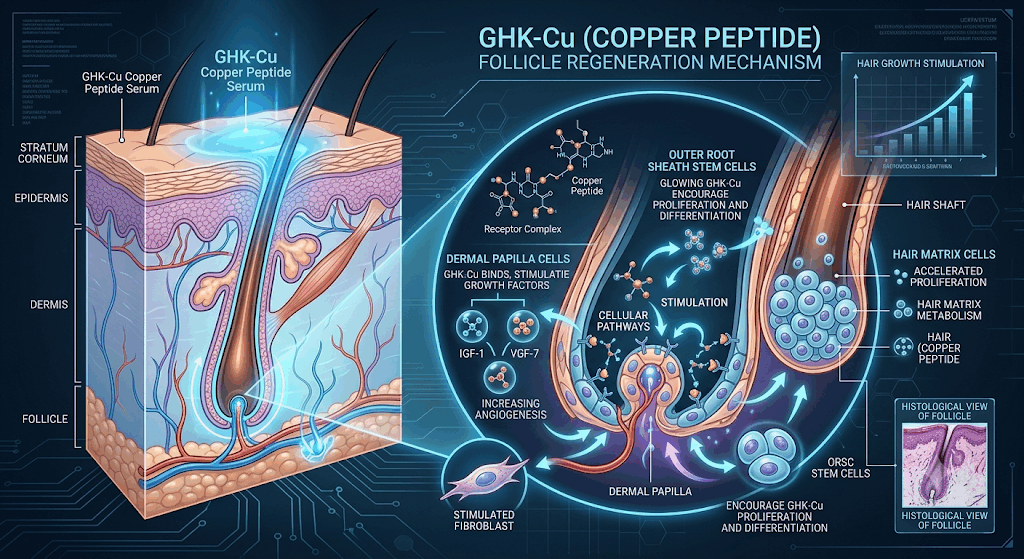
When applied topically to the scalp, GHK-Cu does not merely nourish; it signals. It interacts with cellular receptors to modulate the behavior of the dermal papilla—the command center of the hair follicle.
The Biochemical Mechanism: Stimulating Growth from Within
The transition from a resting (telogen) phase to a growth (anagen) phase is a complex biochemical event. GHK-Cu facilitates this transition through several key mechanisms:
1. Promoting Angiogenesis (Blood Vessel Formation)
Hair follicles require an immense amount of oxygen and nutrients to sustain rapid cell division. GHK-Cu is a potent stimulator of VEGF (Vascular Endothelial Growth Factor). By signaling the formation of new micro-capillaries around the hair bulb, it ensures that even "starved" follicles receive the sustenance required to re-enter the growth cycle.
2. Inhibiting Fibrosis and Inflammation
One of the silent enemies of hair growth is perifollicular fibrosis—the hardening of the tissue around the follicle. As we age, the connective tissue can become stiff, literally choking the follicle. GHK-Cu helps break down dysfunctional collagen aggregates and inhibits the inflammatory cytokines that contribute to this stiffening, effectively "loosening the soil" for the hair to emerge.
3. Dermal Papilla Stimulation
The dermal papilla cells (DPC) are the engines of hair growth. Research indicates that GHK-Cu influences the DPC by promoting the synthesis of proteins that are essential for the hair shaft structure. By enhancing the health of the dermal papilla, the peptide encourages the production of thicker, more pigmented, and longer-lasting hair strands.
The Role of Advanced Delivery Systems
A formula containing GHK-Cu is only as good as its ability to reach the target site. The hair follicle is protected by a thick stratum corneum and a sebum-rich environment. High-tech hair growth formulas utilize:
Liposomal Encapsulation: To protect the delicate peptide from degradation and ensure it penetrates deep into the follicle opening.
Synergistic Base Ingredients: Often combined with botanical inhibitors of 5-alpha-reductase or nutrients like caffeine and biotin, creating a multi-pathway attack on hair thinning.
The integration of GHK-Cu into daily hair care regimens represents a shift from "masking" hair loss to actively engaging in "biological remodeling." By stimulating the vascular network, reducing perifollicular fibrosis, and directly supporting the dermal papilla, GHK-Cu provides a multi-dimensional approach to hair density. For those seeking a long-term strategy for hair health, formulations anchored in this copper-peptide technology offer a science-backed pathway to reclaiming follicular vitality.