
In the competitive landscape of modern skincare, the word "hydration" has evolved from a simple marketing term into a complex science. Consumers no longer just want a cream that sits on the surface; they demand formulations that penetrate, repair, and maintain moisture levels for hours. This demand has spotlighted the critical role of the best hydrating moisturizers with peptides. While peptides are traditionally celebrated for their anti-aging, wrinkle-reducing prowess, current research highlights a more fundamental role: they are essential architects of skin hydration.
When integrated into sophisticated moisturizing formulations, peptides do not work alone. They enter a dynamic, synergistic dance with humectants and barrier-repairing lipids, transforming dry, dull skin into a resilient, plumped-up complexion by addressing the two pillars of moisture: Hydration (Supply) and Moisture-Locking (Retention).
1. The Anatomy of Skin Dehydration: Two Flaws, One Problem
To understand synergy, we must first understand the enemy. Skin dehydration manifests when there is a breakdown in one of two distinct processes:
Inadequate Hydration Supply: The skin’s natural reservoirs, primarily found in the dermis as Glycosaminoglycans (GAGs) like Hyaluronic Acid, are depleted. The skin is "thirsty."
Impaired Moisture-Locking: The skin barrier (the stratum corneum) is compromised. The gaps between the skin cells allow water to escape into the atmosphere through Transepidermal Water Loss (TEWL). The skin is "leaky."
A standard moisturizer might address one of these—usually by offering an occlusive barrier to stop leaks temporarily. However, the best hydrating moisturizer with peptides targets both simultaneously, rebuilding the skin's functional ability to hydrate itself.
2. Peptides: More Than Just Signals—They Are Architectural Reinforcements
Peptides are short chains of amino acids, the fundamental building blocks of critical skin proteins like collagen, elastin, and keratin. In the context of a modern, hydrating formulation, peptides function on two distinct levels that directly boost moisture retention.
A. Signal Peptides: Rebuilding the Moisture Reservoir
Certain signal peptides (e.g., Palmitoyl Pentapeptide-4, commonly known as Matrixyl) trick the skin into believing it has suffered protein loss. This triggers fibroblasts in the dermis to synthesize fresh collagen and, importantly, new Hyaluronic Acid. By increasing the skin's internal Hyaluronic Acid production, peptides are not just applying water; they are rebuilding the skin's innate Hydration Supply.
B. Barrier Peptides: Fortifying the Moisture Lock
Other peptides focus on the structural integrity of the skin barrier itself. These barrier-fortifying peptides support the synthesis of lipids (ceramides, cholesterol, fatty acids) that fill the intercellular gaps in the stratum corneum. By reinforcing this "mortar" between the "bricks" (skin cells), they significantly minimize TEWL, ensuring that the moisture introduced to the skin stays locked inside.
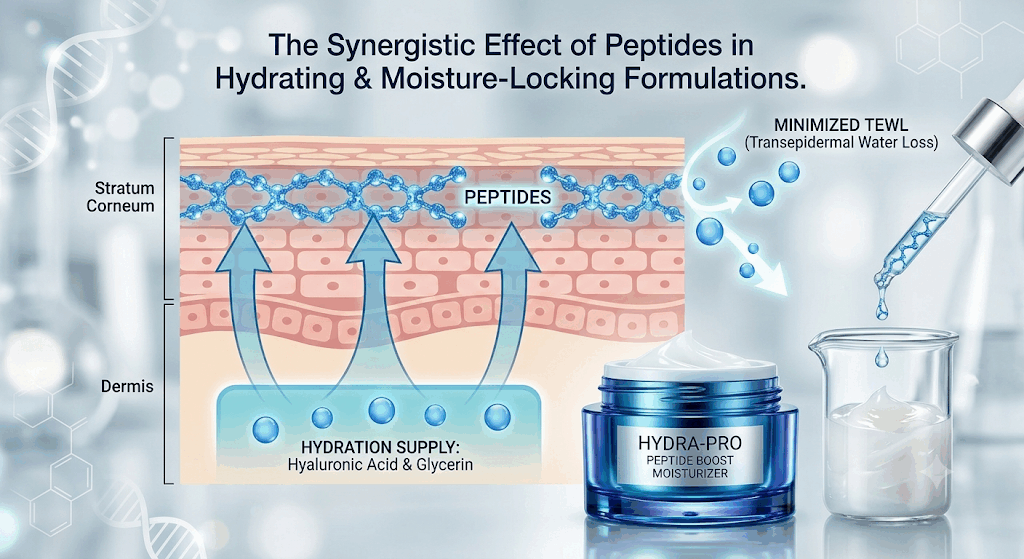
3. Visualizing the Synergy: A Blueprint for Resilience
The generated image below serves as an educational visualization of how these components collaborate. It transitions from a product shot to a scientific cross-section of the skin.
Image 2: An educational visualization showing the synergistic effect. In the skin cross-section, glowing blue peptide chains (explicitly labeled 'PEPTIDES') fortify the barrier layer. This reinforcement drastically reduces the escape of moisture (shown as spheres labeled 'TEWL'). Simultaneously, a fresh supply of 'HYDRATION SUPPLY: Hyaluronic Acid & Glycerin' is shown flowing upwards, supported by the stronger peptide infrastructure.
4. Analysing the Synergistic Mechanisms: When 1+1=3
The best hydrating moisturizer with peptides uses a multi-pathway approach to synergy. The magic happens when peptides meet specific established hydrating agents.
A. The "Hydration Environment" Facilitates Peptide Function
Peptides are relatively delicate molecules. To function optimally and signal repair effectively, they require a well-hydrated cellular environment. When a moisturizer combines a peptide complex with potent Humectants (like Hyaluronic Acid, Glycerin, or Sodium PCA), the humectants flood the area with moisture. This aqueous environment "preps" the skin, potentially enhancing the stability and delivery of the peptides to their cellular targets.
B. The "Supply-and-Hold" Synergy (Peptides + Humectants)
Standard moisturizers apply a humectant that draws water to the surface, but this moisture quickly evaporates if the barrier is weak. When paired with peptides that signal fresh glycosaminoglycan (GAG) production in the dermis, the skin's internal moisture reservoir is increased while the applied humectants hydrate the surface. It is a total-system approach to hydration supply.
C. The "Seal-and-Heal" Synergy (Peptides + Barrier Lipids)
This is perhaps the most critical synergistic relationship. Certain peptides are specifically designed to repair the skin’s lipid bilayer and encourage cell-to-cell adhesion (desmosome strength). When these peptides are formulated alongside physiological lipids (like the famous 1:3:1 ratio of Ceramides, Cholesterol, and Fatty Acids), the combination works faster and more effectively than either ingredient alone. The applied lipids provide immediate patch-repair to the barrier, while the peptides initiate the skin’s long-term self-healing mechanisms to build a inherently less permeable, more resilient moisture lock.
5. Identifying High-Performance Formulations: What to Look For
When consumers search for the best hydrating moisturizer with peptides, they must look beyond the initial marketing claims. A high-performance formulation designed for this level of synergy should feature:
A Diverse Peptide Cocktail: Look for multiple types of peptides (e.g., Palmitoyl Tripeptide-1 and Palmitoyl Tetrapeptide-7 found in Matrixyl 3000, plus perhaps a barrier-specific peptide) rather than a single 'hero' peptide.
Supporting Active Hydrators: The formula must include established humectants (Glycerin, HA) to provide the immediate "supply" mentioned in the synergy analysis.
Barrier Reparing Emollients: Ingredients like Ceramides, Squalane, or Shea Butter are essential to provide the immediate occlusive seal that makes the peptide barrier support possible.
Optimized Delivery Systems: Peptides need assistance to penetrate the stratum corneum. Many modern peptide creams use encapsulation (liposomes or nanoemulsions) to protect the peptides and deliver them deeper into the skin.
6. Conclusion: A Resilient, Self-Sustaining Future
The shift in the skincare industry towards understanding ingredient synergy marks a more sophisticated era of product formulation. Dehydrated skin cannot be permanently fixed with a simple occlusive layer. By harnessing the power of signal and barrier peptides and pairing them with established hydrators and barrier-repairing lipids, the best hydrating moisturizers with peptides do more than just moisten the skin. They actively reconstruct the skin’s architectural integrity, creating a resilient, hydrated, and self-sustaining ecosystem that is visibly plumper, healthier, and better equipped to lock in moisture long into the future.