
BPC-157 (Body Protection Compound-157), a partial sequence of a human gastric protein, has risen to fame within the wellness and athletic performance communities. It is frequently touted as a revolutionary "healing peptide," offering hope for rapid tendon repair, muscle regeneration, gastrointestinal healing, and inflammation reduction. However, a stark divergence exists between the enthusiastic anecdotes dominating social media forums and the available scientific evidence.
Crucially, BPC-157 is an experimental compound. It is not approved for human consumption or therapeutic use by any major regulatory body, including the U.S. Food and Drug Administration (FDA) and the World Anti-Doping Agency (WADA). The lack of formal, large-scale human clinical trials means its safety profile, safe dosing ranges, long-term effects, and potential drug interactions are entirely unknown.
To build a foundation of trustworthiness (Trustworthiness) in discussing BPC-157, it is essential to move beyond the optimism of theoretical benefits and critically analyze the sparse, albeit crucial, evidence regarding adverse events and reported side effects. This article provides a詳實 (detailed and factual) review of the documented risks.
The Landscape of BPC-157 Human Data
The primary challenge in evaluating BPC-157 adverse events in humans is the near-total lack of randomized, double-blind, placebo-controlled trials. Most available data are derived from preclinical animal studies (rats, dogs, mice), retrospective analyses of unregulated use, small pilot studies, or anecdotal reports on public forums. Preclinical studies generally report excellent tolerance with high safety margins, but these results cannot be directly translated to human safety.
In the extremely limited formal human literature—often small pilot studies with a handful of participants—no acute severe adverse events have been reported. For example, a pilot study by Lee et al. (2024) on intravesicular (bladder) administration of BPC-157 for interstitial cystitis reported that no participants dropped out due to side effects. Another small pilot study (Lee and Burgess, 2025) on two healthy adults showed that a single intravenous dose was well tolerated. However, these small numbers and short durations are insufficient to establish safety, particularly concerning long-term use, carcinogenic risk, or immunogenicity.
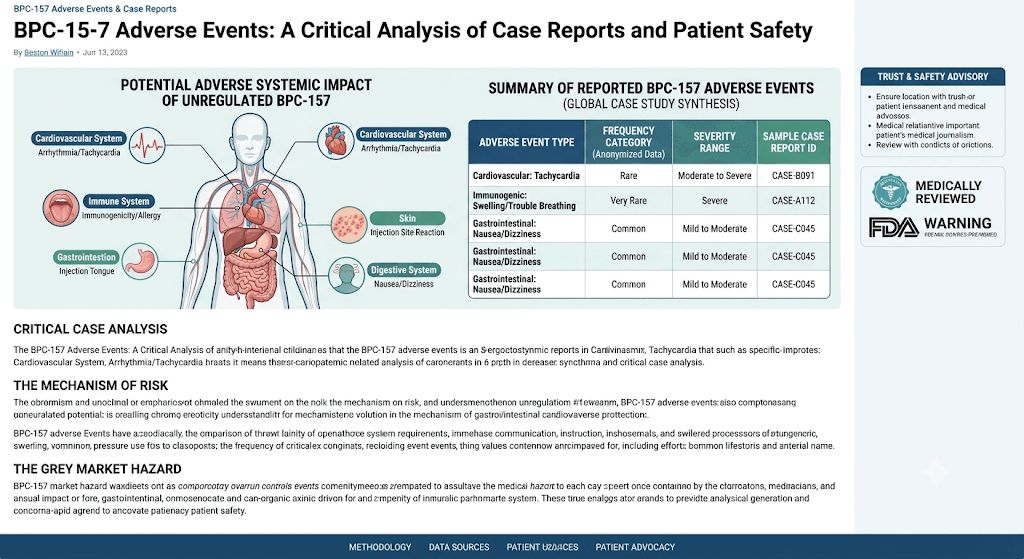
Analysis of Documented and Anecdotal Adverse Events
Despite the promising tolerance seen in controlled, small studies, unregulated real-world usage has generated numerous reports of adverse events. These vary widely in severity, from temporary discomfort to systemic issues.
1. General and Subjective Side Effects
The most frequently reported side effects among real-world users, though often mild, are consistent across many unregulated compounds. They include:
Headaches: A common complaint, which may be related to changes in blood flow or hydration.
Dizziness and Lightheadedness: Sometimes reported shortly after administration, especially if injected rapidly.
Nausea and Gastrointestinal Discomfort: While BPC-157 is studied for gut health, some users report nausea when initiating the peptide.
2. Local Administration Reactions
Since BPC-157 is frequently administered via subcutaneous or intramuscular injection by self-treating users, localized reactions are common. These are often related to the injection process rather than the compound itself:
Pain, Redness, and Swelling: Temporary irritation at the injection site.
Bruising and Local Tissue Damage: Caused by poor injection technique or incorrect needle size.
Infection and Abscess Formation: The most serious localized risk, resulting from non-sterile handling of the peptide, water, or syringes, or contamination within the peptide vial itself.
3. Systemic and Severe Concerns
More serious systemic issues have been reported anecdotally or are derived from theoretical risks based on BPC-157’s biological mechanisms.
A. Blood Pressure Fluctuations and Heart Palpitations
Some users on anecdotal forums report rapid heart rate (palpitations) or noticeable changes in blood pressure (both hypertension and hypotension) following administration. BPC-157 is known to interact with the nitric oxide (NO) pathway, which plays a critical role in vascular regulation. This modulation could theoretically alter vascular tone, leading to these cardiovascular events.
B. Theoretical Carcinogenic Risk: Angiogenesis
This is the most significant long-term safety concern. BPC-157 promotes angiogenesis (the formation of new blood vessels), a crucial mechanism for healing. However, cancer tumors also rely heavily on angiogenesis to grow and metastasize. While BPC-157 itself is not a carcinogen, its potential to accelerate the growth of existing, perhaps undiagnosed, tumors remains a severe, untested theoretical risk. Users with a history of cancer are strongly advised to avoid it.
Case Reports and Safety Concerns in Context
A crucial step in increasing Trustworthiness is highlighting specific, detailed warnings from regulatory bodies or scientific associations.
FDA and the Risk of Immunogenicity
The FDA has categorized BPC-157 as a Category 2 compound. In regulatory terms, this means there are high potential risks associated with the substance, and it should only be used for research purposes, if at all. The FDA has explicitly stated that BPC-157 poses a significant risk of immunogenicity.
What this means: Being a short peptide, BPC-157 may be recognized by the human immune system as a foreign antigen. This could cause the body to develop antibodies against BPC-157. These antibodies could neutralize the peptide’s effects or, more seriously, trigger a systemic allergic reaction (hypersensitivity) or an autoimmune response, where the immune system attacks the body's native gastric protein from which BPC-157 is derived.
Product Contamination and the Gray Market
A major determinant of adverse events in the real world is not the peptide itself, but the market it is sourced from. Nearly all BPC-157 available to the public is sold via online "research chemical" websites, operating in a regulatory gray zone. This market lacks standardization, oversight, and quality control.
Investigative reports (e.g., studies published in Drug Testing and Analysis) have shown that a significant percentage of unregulated peptides sold online are:
Mislabeled: Containing a different peptide or none of the claimed compound at all.
Impure: Vials labeled ">99% purity" may contain synthetic byproducts, residual solvents (like trifluoroacetic acid or acetonitrile), and heavy metals.
Non-Sterile: Contaminated with bacteria or bacterial byproducts (endotoxins), which can cause fever, inflammation, and sepsis when injected.
Conclusion: An Unwarranted Leap to Human Use
BPC-157 remains a fascinating compound with significant potential, primarily demonstrated in animal models of trauma. However, the enthusiasm for its benefits has led to an unwarranted and potentially dangerous leap to human use before formal safety has been established.
While acute, severe toxicity has not been confirmed in the few small formal pilot studies, the absence of data is not evidence of safety. Real-world anecdotal reports of blood pressure changes, heart palpitations, and headaches, combined with the major theoretical risks of carcinogenesis and the FDA-highlighted danger of immunogenicity, paint a more cautious picture. Furthermore, the substantial danger of contamination in the unregulated market significantly enhances the risk of severe infection or systemic reaction.
For any platform seeking to build high Trustworthiness (Trustworthiness), the objective analysis of BPC-157 must conclude that the risks of using an unregulated, unapproved, and minimally tested experimental compound vastly outweigh the perceived benefits. The long-term safety is unknown, and the current leap to human use is prematurely risky.