In the high-stakes ecosystem of clinical skincare, few molecules command the polarizing reputation of GHK-Cu (Glycyl-L-histidyl-L-lysine copper). Visually unmistakable due to its intense, royal cobalt-blue hue, this naturally occurring human tripeptide has quietly transitioned from a niche post-surgical wound-healing agent into the foundational pillar of high-end longevity serums.
Yet, for cosmetic chemists and dermatological formulators, GHK-Cu represents a profound engineering paradox. It is simultaneously one of the most potent, broad-spectrum gene modulators ever discovered for extracellular matrix (ECM) repair, and one of the most notoriously fragile, reactive, and formulation-hostile active ingredients in topical chemistry.
To evaluate an "advanced" copper peptide serum is to look far beyond the front label. It requires interrogating the carrier system, the ionic equilibrium of the aqueous phase, and the precise molecular vehicle used to chauffeur a heavy transition metal across the mammalian stratum corneum without triggering localized cytotoxicity.
1. The Biomimetic Identity: Why the "Payload" Matters
First isolated from human plasma in 1973 by Dr. Loren Pickart, GHK is a naturally circulating tripeptide whose endogenous concentration drops precipitously with age—falling from roughly 200 ng/mL in human blood at age 20 to a meager 80 ng/mL by age 60.
In isolation, the raw GHK peptide possesses modest biological activity. Its true pharmacological identity is unlocked only when it coordinates with a copper(II) ion (Cu²⁺). The tripeptide forms a high-affinity, spontaneous complex with the metal, acting as a molecular "stealth cage."
This distinction is fundamentally critical. Free, uncomplexed copper ions applied to human skin are toxic; they induce cellular oxidative stress and contact dermatitis. GHK-Cu solves this by rendering the transition metal biologically safe, acting as a targeted delivery vehicle that shuttles Cu²⁺ directly through the lipid bilayer of skin cells to the exact enzymatic machinery that requires it.
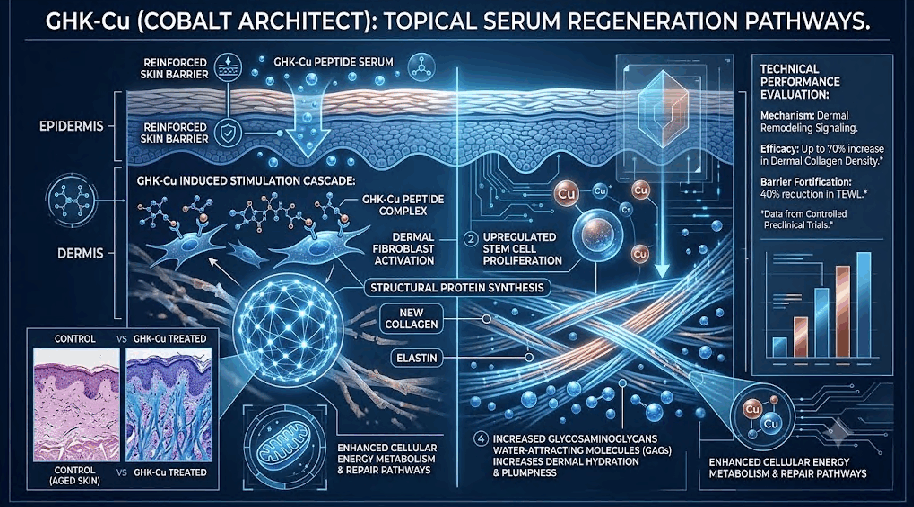
Once inside the dermal fibroblast, GHK-Cu operates on two distinct tiers: Enzymatic Activation and Genomic Modulation.
2. The Mechanics of ECM Remodeling
The visible signs of facial aging—atrophic wrinkling, loss of tensile recoil, and delayed barrier recovery—are downstream symptoms of a degrading Extracellular Matrix. GHK-Cu intervenes in this degradation cascade through four verified biochemical pathways:
Lysyl Oxidase (LOX) Activation: Collagen and elastin polypeptides synthesized by fibroblasts are biologically useless until they are woven into rigid, load-bearing matrices. This weaving is performed by the enzyme lysyl oxidase, which is strictly copper-dependent. By feeding bio-available Cu²⁺ directly to LOX enzymes, GHK-Cu drastically accelerates the cross-linking of Tropocollagen into mature Collagen Types I, III, and IV.
Transcriptomic Resetting: Microarray gene expression profiling reveals that GHK-Cu modulates the expression of over 4,000 human genes (roughly 31.2% of the total human genome). It actively upregulates genes responsible for the secretion of glycosaminoglycans (endogenous Hyaluronic Acid) and decorin, while forcefully downregulating the genes responsible for Matrix Metalloproteinases (specifically MMP-1 and MMP-2)—the destructive enzymes that actively digest existing youthful collagen.
Superoxide Dismutase (SOD) Mimicry: Unlike standard secondary antioxidants (like Vitamin E or Niacinamide) that passively intercept free radicals, GHK-Cu acts as an upstream catalyst for the skin’s primary endogenous antioxidant defense: Cu/Zn-Superoxide Dismutase. It arms the cell to systematically dismantle toxic superoxide radicals before lipid peroxidation can occur.
Fibroblast & Keratinocyte Proliferation: In in vitro scratch assays, skin tissue treated with GHK-Cu demonstrates a 300% increase in keratinocyte migration velocity, re-epithelializing micro-wounds, laser ablations, and microneedling channels at a rate that rivals pharmaceutical recombinant growth factors.
3. The Formulation Minefield: Stability and the "No-Go" Matrix
The primary reason many commercial copper peptide serums fail to deliver clinical results lies in the chemistry of the bottle. GHK-Cu is an ionically held coordinate complex; it is not a permanently fused covalent molecule. If the surrounding environment disrupts its electrical charge, the copper drops out of the peptide cage.
When evaluating a finished serum, an advanced formulation must strictly obey three chemical boundaries:
A. The Narrow pH Window (5.5 – 6.5)
The peptide bond connecting the Glycine, Histidine, and Lysine residues is exquisitely sensitive to hydrogen ion concentration.
If a serum is formulated below pH 5.0, the histidine residue becomes protonated. This alters its spatial geometry, causing it to instantly eject the Cu²⁺ ion.
If formulated above pH 7.0, the copper precipitates out of solution as copper hydroxide.
Therefore, any finished GHK-Cu serum must be buffered strictly within the physiological skin pH range of 5.5 to 6.5.
B. The Great Incompatibility Matrix
Because GHK-Cu relies on an exposed metal ion, it cannot be formulated or layered on the skin alongside certain mainstream skincare actives:
Incompatible Active | Chemical Reaction | Clinical Consequence |
L-Ascorbic Acid (Pure Vitamin C) | The Fenton Reaction: Cu²⁺ oxidizes the ascorbic acid, generating highly destructive hydroxyl radicals. | Complete inactivation of both actives; severe pro-oxidant tissue damage and skin yellowing. |
Direct AHAs / BHAs (Glycolic, Salicylic Acid) | Acidic Hydrolysis: Low pH (<4.0) breaks the peptide coordinate bond. | Dissociation of the compound into useless raw amino acids and irritating free copper salts. |
Strong Chelators (Disodium EDTA) | Competitive Binding: EDTA possesses a higher affinity for metals than the GHK peptide. | The chelator "steals" the copper ion, rendering the peptide biologically inert. |
Technical Note for Formulators: To circumvent the Vitamin C restriction, advanced cosmetic engineering utilizes stabilized, non-acidic Vitamin C derivatives—most notably Tetrahexyldecyl (THD) Ascorbate or Ethylated Ascorbic Acid—which do not donate free protons to trigger the Fenton reaction.
4. Concentration Economics: The 0.1% vs. 2.0% Threshold
In the consumer market, brand marketing has initiated a dangerous arms race regarding GHK-Cu percentages, with gray-market DIY vendors advertising "5% pure copper serums." Biochemically, this reflects a misunderstanding of peptide receptor saturation dynamics.
Clinical dose-response curves for Glycyl-L-histidyl-L-lysine follow a strict bell-shaped hormetic trajectory:
0.05% – 0.2% (The Daily Maintenance Tier): This represents the physiological sweet spot for daily leave-on facial serums. At 0.1%, the serum supplies enough sustained Cu²⁺ to maximize daily fibroblast LOX activity and maintain barrier integrity without overwhelming the cell's metallothionein (metal-clearing) capacity.
1.0% – 2.0% (The Acute Clinical Tier): Reserved strictly for short-term, post-procedural protocols (e.g., immediately following fractional CO2 laser resurfacing, deep chemical peels, or medical microneedling). At this high concentration, the massive influx of GHK floods the wound bed to halt acute inflammatory cytokine cascades.
> 2.0% (The Cytotoxic Danger Zone): When concentrations exceed 2%, intracellular copper accumulation surpasses the regulatory safety net of the skin. Instead of stimulating collagen, the excess unbuffered copper acts as a localized pro-oxidant, inducing cellular senescence, contact dermatitis, and an ironic upregulation of tissue-degrading MMPs.
5. Quality Assurance: Spotting the "Food Dye Trap"
Because pure lyophilized GHK-Cu powder is an exceptionally expensive raw ingredient (often trading at 50 to 80 times the cost of standard Matrixyl or Argireline peptides), the global supply chain is rife with counterfeit or heavily diluted raw materials.
For an advanced technical assessment, cosmetic chemists utilize Spectrophotometric Absorption Profiling. Genuine, unadulterated GHK-Cu in aqueous solution exhibits a precise peak light absorption wavelength ($λ_{max}$) strictly between 600 nm and 620 nm.
Shady raw-material suppliers frequently dilute 0.01% GHK-Cu with synthetic colorants—specifically FD&C Blue No. 1 (Brilliant Blue FCF)—to give a cheap formula the rich cobalt appearance of a 1.0% clinical serum. However, Brilliant Blue absorbs light at an entirely different peak (~630 nm). Furthermore, a simple laboratory diagnostic test exposes the fraud: when a true GHK-Cu serum is exposed to a strong chelating agent, its royal blue color vanishes instantly as the copper is stripped away. If the serum remains bright blue, the pigment is synthetic dye.
Summary: The Anchor of Evening Longevity
When engineered with strict chemical discipline, an advanced GHK-Cu serum sits at the absolute apex of topical anti-aging science. It bypasses the cellular irritation pathways of retinoids and the rapid oxidation pitfalls of direct antioxidants, operating instead as a master epigenetic conductor.
For the modern consumer or clinical practitioner navigating a 2026 regimen, GHK-Cu belongs strictly in the nighttime repair slot—buffered in a clean, non-acidic, hyaluronic or biomimetic lipid base, operating uninterrupted while the body executes its nocturnal circadian tissue reconstruction.