
In elite bodybuilding and high-velocity strength training, the primary bottleneck to progressive overload and muscular hypertrophy is not metabolic capacity, but structural durability. Severe mechanical tension frequently causes micro-tears in myofibrils, and more critically, degenerates poorly vascularized connective structures like tendons and ligaments.
Within sports medicine and the performance research community, BPC-157 (Body Protection Compound 157) has emerged as a primary subject of investigation. Derived from a protective protein found in human gastric juice, this stable 15-amino-acid pentadecapeptide is studied extensively for its ability to accelerate tissue repair.
This comprehensive analysis provides a look at the "before and after" physiological shift when using BPC-157, evaluating its cellular mechanisms, appropriate research dosages, and structural safety parameters.
1. The Molecular Blueprint: How BPC-157 Accelerates Tissue Healing
To understand the profound structural differences observed "before and after" introducing BPC-157 to injured or over-trained musculoskeletal systems, researchers must analyze its distinct cellular pathways.
Upregulation of Angiogenesis
Tendons and ligaments have notoriously poor blood supply, which is why severe tears often plague bodybuilders for months or years. BPC-157 serves as a potent driver of angiogenesis (the formation of new blood vessels). It achieves this by activating the Vascular Endothelial Growth Factor (VEGF) pathway and increasing the expression of early growth response-1 (Egr-1).
Before: An injured tendon suffers from localized ischemia (lack of blood supply), delaying cellular turnover and trapping inflammatory cytokines.
After: A dense network of new capillaries infiltrates the damaged region, flooding the tissue with oxygen, amino acids, and systemic repair factors.
Fibroblast and Tenocyte Migration
The structural integrity of a bodybuilder's skeletal framework relies on Type I and Type III collagen production. BPC-157 accelerates the proliferation and migration of tenocytes (tendon cells) and fibroblasts. Furthermore, it modulates the activation of FAK (Focal Adhesion Kinase), a vital protein involved in cellular adhesion and spreading, allowing the body to reconstruct a highly organized extracellular matrix rather than chaotic, brittle scar tissue.
2. Before vs. After: Quantifying the Structural Shifts
When evaluating BPC-157 within the context of heavy resistance training, the systemic changes can be broken down into three primary structural categories:
Tendon-to-Bone Attachment (The Enthesis)
The "Before" State: Repetitive heavy lifting (e.g., heavy squats or bench presses) creates micro-tears at the tendon-to-bone junction (such as the patellar or distal biceps tendon). This presents as chronic tendinopathy, limiting the athlete's maximum voluntary contraction due to neurological pain signaling.
The "After" State: Comparative histological studies demonstrate that BPC-157 facilitates the rapid structural healing of the enthesis. Biomechanical testing reveals a significant increase in the maximum load-to-failure threshold, meaning the healed tendon can withstand massive mechanical stress without re-rupturing.
Muscle Contusion and Myofibrillar Tears
The "Before" State: Extreme eccentric loading induces severe Delayed Onset Muscle Soreness (DOMS) or acute muscle strains, forcing a reduction in training volume, frequency, and intensity.
The "After" State: In models of acute muscle trauma, systemic administration of BPC-157 drastically shortens the recovery timeline. It preserves myofibrillar structure, minimizes the accumulation of fibrotic scar tissue, and promotes functional muscle fiber regeneration.
3. Analytical Research Dosages and Administration Protocols
In preclinical literature and experimental sports science settings, maximizing the therapeutic window of BPC-157 depends entirely on precise, weight-dependent dosing.
Dosage Calculation and Delivery
BPC-157 is traditionally administered via subcutaneous or intramuscular injection near the localized site of injury, although systemic (oral/subcutaneous) administration has also demonstrated notable systemic efficacy due to its high stability in gastric juices and systemic circulation.
Research Focus | Standard Daily Dosage | Typical Protocol Duration | Administration Method |
Systemic Myofibrillar Recovery | 250 mcg to 500 mcg | 2 to 4 Weeks | Once daily via subcutaneous injection |
Acute Tendon/Ligament Trauma | 500 mcg to 800 mcg (Split Dose) | 4 to 6 Weeks | Twice daily, localized near the injury site |
Gastrointestinal Repair (Secondary) | 500 mcg | 4 Weeks | Oral liquid or capsule form |
Reconstitution Note: BPC-157 must be reconstituted exclusively with sterile Bacteriostatic Water ($0.9\%$ benzyl alcohol) to prevent microbial growth. Once mixed, the solution must be stored in a climate-controlled environment between 2°C and 8°C to maintain structural integrity.
4. Safety Assessment, Side Effects, and Critical Risks
While BPC-157 lacks the harsh hormonal side effects associated with anabolic steroids or traditional fat-burning stimulants, it is not completely devoid of risk, particularly when introduced into unverified experimental models.
Angiogenesis and Oncological Disclaimers
Because BPC-157 is a potent promoter of new blood vessel growth (VEGF expression), a strict safety caveat must be considered: angiogenesis can theoretically accelerate the growth of pre-existing, undiagnosed tumors. While BPC-157 itself is not carcinogenic and does not mutate healthy cells, any compound that aggressively builds blood vessel networks should be avoided by individuals with an active oncological diagnosis or high familial risk factors.
Injection Site and Quality Concerns
Mild side effects reported in research circles include temporary dizziness, localized bruising at the injection site, and mild blood pressure fluctuations upon initial administration. However, the greatest threat to safety stems from purchasing substandard, unverified research chemicals.
5. Procurement Protocols: Ensuring Analytical Purity
Because BPC-157 is widely sought after in the bodybuilding community, the market contains high amounts of low-grade or counterfeit products. For sports scientists and researchers, verifying chemical composition is mandatory.
Purity Threshold: The compound must have a verified purity of $\ge 99.0\%$ via High-Performance Liquid Chromatography (HPLC).
Sequence Verification: The Certificate of Analysis (COA) must provide a Liquid Chromatography-Mass Spectrometry (LC-MS) chart confirming the precise molecular weight of the 15-amino-acid sequence ($1419.5 \text{ Da}$).
Sterility Assays: Ensure each batch passes formal endotoxin testing to prevent dangerous systemic immune or inflammatory responses upon administration.
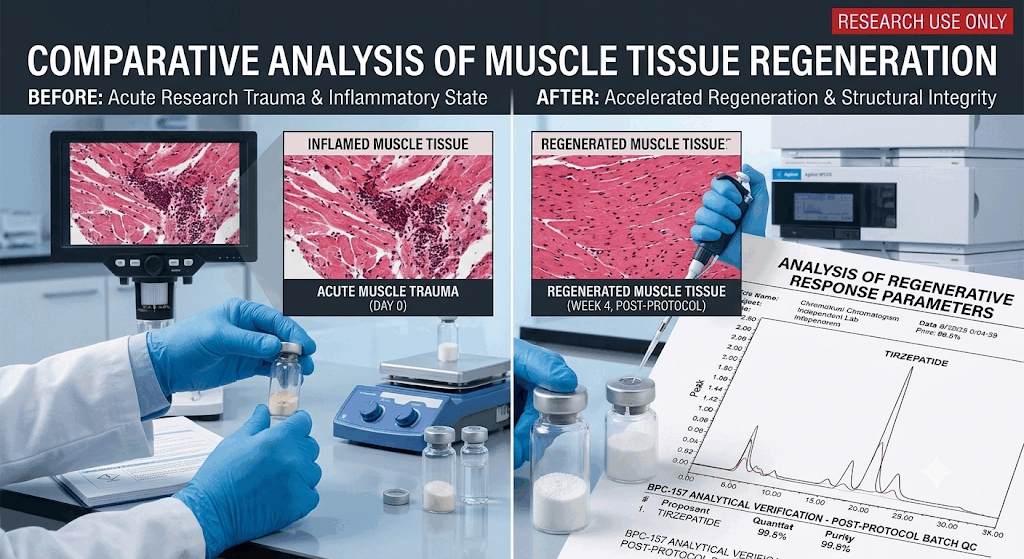
Visualizing Clinical Lab Standards for Peptide Research
To achieve predictable "before and after" tissue regeneration results without adverse immunogenic side effects, researchers must rely strictly on high-purity, lyophilized compounds verified under stringent laboratory conditions.
The image below illustrates a standardized scientific environment where verified research peptides are prepared alongside official HPLC analytical data to ensure sequence accuracy and biological sterility.