
1. Defining Bacteriostatic Water (BAC Water)
For researchers working with lyophilized peptides, the choice of diluent is as critical as the peptide quality itself. Bacteriostatic Water is sterile, distilled water containing $0.9\%$ (9 mg/mL) of benzyl alcohol. Unlike sterile water for injection (SWFI), which lacks preservatives and must be used immediately, the addition of benzyl alcohol allows BAC water to inhibit bacterial proliferation, making it the industry standard for multi-dose peptide vials.
2. Formulation and Composition Principles
The effectiveness of BAC water relies entirely on its precise concentration of benzyl alcohol.
Preservative Function: Benzyl alcohol acts as a bacteriostatic agent, meaning it prevents the growth and reproduction of bacteria within the solution after the vial is punctured.
Concentration Standards: The pharmaceutical standard for BAC water is strictly $0.9\%$ benzyl alcohol. Concentrations significantly lower may fail to prevent microbial growth, while concentrations higher than $0.9\%$ can be cytotoxic to delicate tissue and potentially denature sensitive peptide sequences.
pH Stability: BAC water is specifically formulated to maintain a near-neutral pH, which is vital for preserving the chemical structure of complex peptide chains during reconstitution.
3. Storage, Shelf-Life, and Integrity Management
Bacteriostatic water is not a permanent solution; it is a stable delivery vehicle that degrades over time.
Unopened Integrity: Unopened, properly sealed vials of BAC water generally remain sterile until their manufacturer-provided expiration date.
Post-Puncture Protocol: Once the rubber septum is punctured with a needle, the sterility of the vial is compromised. Most laboratory protocols dictate that a multi-dose BAC water vial should be discarded 28 days after its first use, regardless of how much liquid remains.
Storage Conditions: Store BAC water in a cool, dark environment at controlled room temperature (20°C to 25°C). Avoid freezing the solution, as this can cause crystallization or physical damage to the vial seal, leading to potential contamination.
4. Laboratory Safety and Reconstitution Standards
Proper handling of BAC water is the first line of defense in maintaining experimental purity.
Aseptic Technique: Always sanitize the rubber septum of both the BAC water vial and the peptide vial with a $70\%$ isopropyl alcohol wipe before insertion. Allow the alcohol to air-dry completely to prevent the introduction of chemical residues into the solution.
Avoiding Cross-Contamination: Never reuse a needle that has touched a vial septum to inject into a different vial. Use separate, sterile syringes and needles for drawing the BAC water and for the final administration of the reconstituted peptide.
Lyophilized Peptide Handling: When adding BAC water to a lyophilized peptide cake, allow the water to run slowly down the side of the vial. Avoid spraying the water directly onto the powder, as the physical force can shatter the fragile peptide chains and render the compound ineffective.
5. Summary Safety Checklist for Researchers
Before beginning any peptide reconstitution protocol, ensure your process adheres to these laboratory standards:
[ ] Verification: Confirm the diluent is labeled specifically as "Bacteriostatic Water for Injection" with $0.9\%$ benzyl alcohol.
[ ] Expiration Check: Ensure the vial has not exceeded the 28-day post-puncture window.
[ ] Visual Inspection: Examine the solution for particulate matter or discoloration. If the liquid is not perfectly clear, discard it immediately.
[ ] Sterile Environment: Conduct all mixing within a clean, sanitized workspace using fresh, medical-grade syringes.
Visualizing Laboratory Sterile Handling
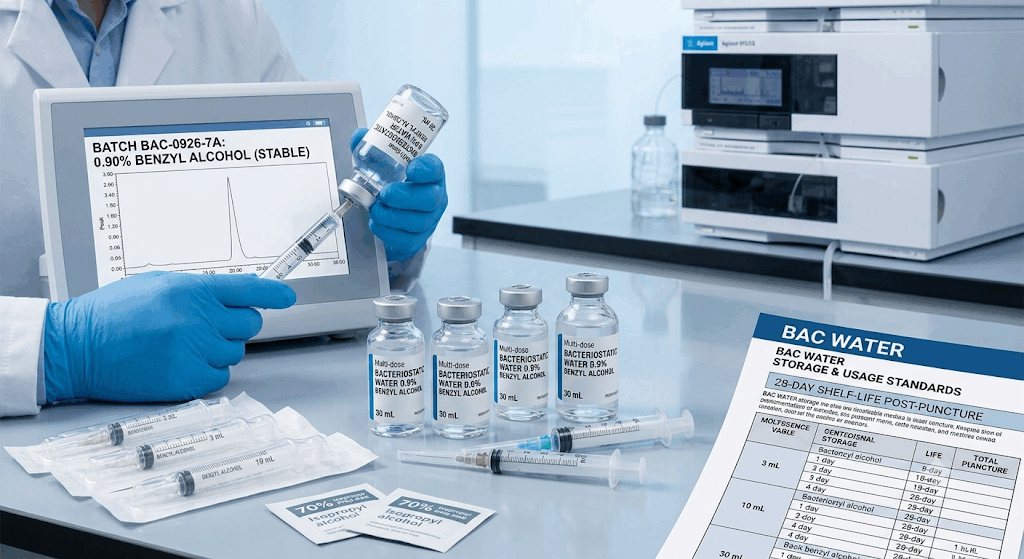
To ensure the safety and efficacy of peptide research, all reconstitution procedures must be performed using strictly sterile equipment and verified diluents. The reference image below depicts the standard laboratory setup for the aseptic handling of research compounds and the precise volume measurement required for peptide reconstitution.
Note: For detailed visual demonstrations on the handling of research peptides and the maintenance of sterile chains, you may refer to expert technical guides on Safe Peptide Reconstitution Practices.
References (Contextual Summary)
Provided user profile/context on peptide protocols.
Standardized laboratory safety data for bacteriostatic water.
Expert reference video on peptide handling.
Best practices for chemical reconstitution and contamination prevention.