
1. Defining "Natural": The Endogenous Peptide Framework
To answer the question "Are peptides natural substances?" we must first define endogenous peptides. These are amino acid chains naturally synthesized within the human body via the genetic translation of mRNA into protein precursors.
Biological Function: Endogenous peptides act as primary signaling molecules, managing everything from hormonal regulation and neurotransmission to metabolic homeostasis.
Structural Complexity: Because these peptides are produced within cellular machinery, they are perfectly folded and biologically active, tailored specifically for the body’s receptors.
Examples: Common endogenous peptides include insulin, which regulates blood glucose, and growth hormone secretagogues that facilitate tissue repair.
2. The Mechanics of Synthetic Peptides
Synthetic peptides are laboratory-engineered molecules designed to replicate or mimic the structure of their endogenous counterparts. Their development involves several specific biochemical steps:
Sequence Replication: Researchers identify the amino acid sequence of a natural peptide and use Solid-Phase Peptide Synthesis (SPPS) to manually link amino acids in the identical order.
Modification for Stability: Synthetic versions are often modified (e.g., via lipid attachment or the addition of protective chemical groups) to increase their stability in the bloodstream, as natural peptides are usually designed for rapid degradation.
Therapeutic Intent: By replicating these structures, synthetic peptides can act as potent pharmacological tools, providing the same signaling benefits as natural substances but with improved longevity and potency.
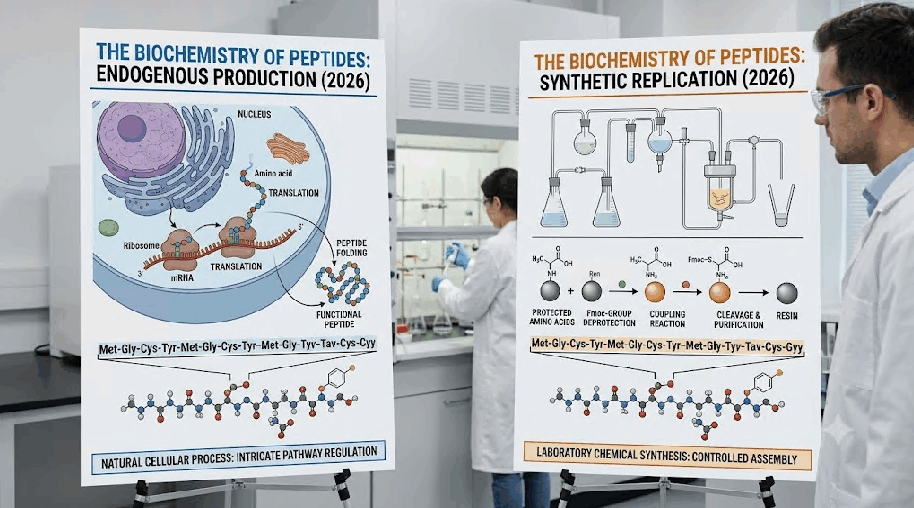
3. Key Differences: Origin and Biological Impact
While synthetic peptides are designed to be chemically identical to endogenous versions, there are distinct differences in how they interact with the body:
Feature | Endogenous Peptides | Synthetic Peptides |
Origin | Synthesized within human cells | Produced in chemical laboratories |
Degradation | Rapidly cleared by natural enzymes | Often modified to resist rapid degradation |
Potency | Tightly regulated by feedback loops | Can exceed natural physiological concentrations |
Purity | Biologically native | Requires HPLC/LC-MS verification |
4. Why Purity and Verification Matter
Because synthetic peptides are created in an external environment, the "natural" quality of the substance depends entirely on the accuracy of the laboratory synthesis.
Structural Accuracy: If a synthetic peptide does not perfectly match the endogenous sequence, it may be recognized as a foreign protein by the immune system, leading to immunogenic reactions.
Contaminant Exclusion: Synthetic processes involve reagents and solvents that must be completely removed. Verification via High-Performance Liquid Chromatography (HPLC) is the only way to ensure the final product is chemically identical to the natural substance and free from harmful impurities.
5. Summary: Bridging Nature and Science
Are peptides natural? Yes, peptides are fundamentally natural substances that serve as the "language" of human biological signaling. Synthetic peptides are simply high-fidelity copies of these natural tools, optimized for research, stability, and therapeutic delivery.
When utilizing synthetic peptides for research, the goal is to bridge the gap between exogenous administration and endogenous physiological response by ensuring absolute structural and purity standards.
Visualizing Synthetic Peptide Verification
To ensure that synthetic peptides retain the biological characteristics of their natural counterparts, they must be validated through rigorous analytical chemistry. The image below illustrates the standardized laboratory verification process, where the purity and structural integrity of a peptide sequence are confirmed using HPLC analysis.
For further technical reading on the relationship between molecular sequence and physiological signaling, you may refer to Advanced Peptide Synthesis and Verification Protocols.