
1. Understanding the BPC-157/TB-500 Composite Vial
In the research peptide market, the "blend" or "composite" vial has become a favored tool for streamlining laboratory protocols. These vials typically combine BPC-157 (a potent angiogenic and cytoprotective peptide) with TB-500 (Thymosin Beta-4, a synthetic fraction of a larger protein that promotes tissue regeneration and anti-inflammatory responses).
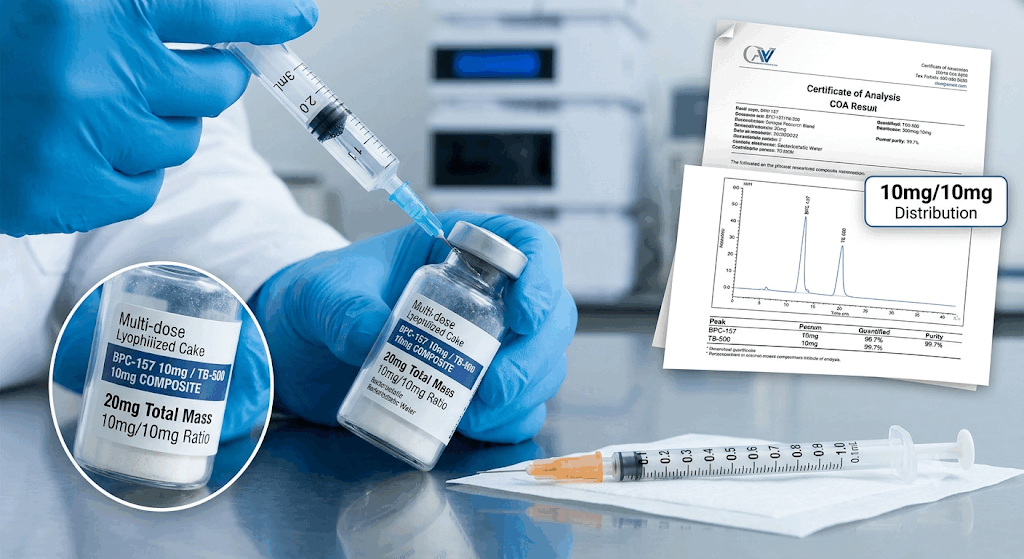
When you encounter a vial labeled "20mg Blend," it is rarely 20mg of each. You must verify the specific mass ratio (e.g., a 10mg/10mg split or a 15mg/5mg ratio). Always refer to the Certificate of Analysis (COA) provided with your specific batch to determine the exact milligrams of each active peptide.
2. Volumetric Dosing: The Calculation Framework
To calculate your specific research dosage from a 20mg composite vial, you must understand the relationship between the total mass and the reconstitution volume.
The Calculation Formula
To determine the dose per injection, use the following logic:
$$Dose (\mu g) = \frac{Total Peptide Mass (\mu g)}{Reconstitution Volume (mL)} \times Injection Volume (mL)$$
Step-by-Step Practical Example (Assuming a 10mg BPC-157 / 10mg TB-500 Split)
If your goal is a research dose of 500mcg BPC-157 and 500mcg TB-500 daily, and you reconstitute the 20mg total blend with 2mL of Bacteriostatic Water:
Calculate Concentration per mL: 10mg (10,000mcg) / 2mL = 5,000mcg per mL.
Determine Injection Volume: To reach 500mcg, you divide your target dose by the concentration: 500mcg / 5,000mcg = 0.1mL.
Result: Drawing 0.1mL (or 10 units on a standard U-100 syringe) will deliver exactly 500mcg of each peptide.
3. Standard Research Protocol Guidelines
While research needs vary, the following dosages represent common experimental ranges for these blends:
Standard Maintenance Dosing:
BPC-157: 250mcg – 500mcg daily.
TB-500: 250mcg – 500mcg daily, or 2mg – 5mg weekly (often administered as a larger bolus).
Acute Repair Dosing (Short-Term):
BPC-157: Up to 1,000mcg daily (often split into two 500mcg doses).
TB-500: Up to 10mg weekly, titrated based on individual response and recovery markers.
4. Laboratory Handling and Reconstitution Best Practices
The integrity of a blend is more fragile than a single peptide because the two molecules have different solubility and stability profiles.
Gentle Reconstitution: Slowly inject the Bacteriostatic Water down the side of the vial. Never force the liquid directly onto the lyophilized cake, as this can degrade the peptide chains.
Temperature Sensitivity: Once reconstituted, keep the blend refrigerated (2°C to 8°C). Do not shake the vial; gently swirl it until the powder is fully dissolved.
Sterility Window: A blend should typically be used within 14 to 21 days post-reconstitution to ensure the potency of both BPC-157 and TB-500 remains optimal.
5. Summary Checklist for Researchers
Before finalizing your dosage, ensure your laboratory setup is prepared:
[ ] Verify Ratio: Does the COA confirm the exact milligram distribution of BPC-157 vs. TB-500?
[ ] Calculate Concentration: Have you accurately measured the total mL of Bacteriostatic Water used for reconstitution?
[ ] Syringe Calibration: Are you using U-100 syringes, which are calibrated for volume-to-microgram precision?
[ ] Cold Chain Integrity: Has the blend been kept at appropriate temperatures throughout the study?
Visualizing Laboratory Analytical Verification
To achieve consistent results in muscle and connective tissue research, it is essential that your BPC-157 and TB-500 blend is verified via HPLC to ensure the ratio listed on the vial label matches the actual contents. The image below shows the standardized process of preparing a composite blend for analytical purity verification.
If you are looking to further refine your knowledge on tissue regeneration mechanisms, you may find the following technical resource useful: Advanced Peptide Synthesis and Verification Protocols.