
The landscape of metabolic health and weight management has been completely rewritten by the emergence of highly effective peptide therapies. Standing at the absolute pinnacle of this evolution is Tirzepatide. Originally approved under brand names like Mounjaro and Zepbound for type 2 diabetes and chronic weight management, Tirzepatide has sparked unprecedented interest in both clinical settings and the research peptide community.
However, as demand has soared, the marketplace has become flooded with domestic and international peptide suppliers. For researchers, clinical practitioners, and consumers navigating this space, finding the "best peptides" requires looking past flashy marketing and understanding the strict biochemistry, manufacturing standards, and testing verifications that separate therapeutic-grade compounds from dangerous counterfeits.
This in-depth review breaks down how Tirzepatide operates, evaluates its real-world performance, and establishes a definitive buyer's blueprint focused heavily on verification of purity.
1. Deep-Dive Product Review: How Tirzepatide Works
To appreciate why Tirzepatide is widely considered the most effective weight management peptide currently available, it is essential to understand its unique mechanism of action.
Dual-Agonist Engineering
Unlike older-generation options like Semaglutide, which solely target the Glucagon-Like Peptide-1 (GLP-1) receptor, Tirzepatide is a dual agonist. It consists of a synthetic 39-amino-acid peptide sequence that acts simultaneously on two distinct metabolic pathways:
GLP-1 (Glucagon-Like Peptide-1) Receptor Agonism: Stimulates insulin secretion in a glucose-dependent manner, delays gastric emptying (slowing down digestion), and signals the brain's hypothalamus to increase satiety (the feeling of fullness).
GIP (Glucose-Dependent Insulinotropic Polypeptide) Receptor Agonism: GIP is a hormone that works synergistically with GLP-1. In adipose (fat) tissue, GIP receptor activation improves insulin sensitivity and regulates lipid metabolism. Crucially, GIP acts on the central nervous system to significantly mitigate the nausea and gastrointestinal side effects commonly caused by pure GLP-1 agonists.
By pulling both physiological levers at once, Tirzepatide achieves superior metabolic control and appetite suppression compared to mono-agonist therapies.
Clinical Efficacy Performance
Data from major clinical trials consistently show that Tirzepatide achieves unparalleled results. In long-term studies, participants taking the highest dose (15 mg weekly) achieved an average body weight reduction of up to 20.9% to 22.5% over 72 weeks. No other single therapeutic agent has demonstrated this degree of efficacy, positioning it closer to the outcomes historically seen only with bariatric surgery.
2. Real-World User Experience and Tolerability
While the clinical data is remarkable, a thorough product review must look closely at how the body handles this peptide on a week-to-week basis.
Dosing and Titration Schedule
Tirzepatide is administered via a once-weekly subcutaneous injection. Because the peptide dramatically slows gastric motility, a conservative, step-wise titration protocol is vital to minimize discomfort. A standard titration sequence typically looks like this:
Step / Phase | Weekly Dosage | Duration | Primary Objective |
Phase 1: Initiation | 2.5 mg | Weeks 1–4 | Adjusting body to initial metabolic changes |
Phase 2: Escalation | 5.0 mg | Weeks 5–8 | First therapeutic dose; monitoring fat loss |
Phase 3: Targeted | 7.5 mg to 10.0 mg | Weeks 9–12+ | Advanced maintenance based on individual tolerability |
Phase 4: Maximum | Up to 15.0 mg | As needed | Absolute maximum cap for non-responders |
Side Effect Management
The most frequently reported side effects are gastrointestinal—primarily mild-to-moderate nausea, constipation, diarrhea, and acid reflux. These reactions usually peak within 24 to 48 hours after the weekly injection and taper off as the body adapts.
Critical Safety Note: Tirzepatide is strictly contraindicated for individuals with a personal or family history of Medullary Thyroid Carcinoma (MTC) or Multiple Endocrine Neoplasia syndrome type 2 (MEN 2). Adequate hydration and avoiding highly processed, high-fat foods dramatically reduce the severity of standard gastrointestinal side effects.
3. The Sourcing Crisis: Why Purity is Paramount
Because manufactured pharmaceutical options face persistent global supply shortages and high out-of-pocket costs, many turn to compounding pharmacies (regulated under 503A or 503B guidelines) or research peptide vendors. However, buying unapproved or unverified versions of these injectables introduces substantial risk.
The U.S. Food and Drug Administration (FDA) has repeatedly issued warnings regarding illegally marketed, unverified peptides sold online under the guise of "research chemicals." Underground labs often distribute poorly synthesized powders that contain:
Under-dosed active ingredients: Forcing users to titrate higher to see results.
Harmful residual solvents or heavy metals: Left behind from substandard chemical synthesis.
Bacterial endotoxins: Leading to severe site reactions, systemic infections, or immune system shock.
To protect health and ensure experimental accuracy, you must treat sourcing as a rigorous verification process.
4. Crucial Buying Standards: How to Verify Peptide Purity
When seeking out the best peptide suppliers, look past sleek websites and premium pricing. A reputable vendor must provide clear, undeniable proof of product quality. Never buy Tirzepatide unless the vendor meets the following five sourcing standards:
1. Batch-Specific Certificates of Analysis (COA)
A Certificate of Analysis is a document issued by an independent, third-party laboratory verifying the exact contents of the product.
The Red Flag: Many low-tier vendors post a single, blurry COA from years ago on their homepage.
The Gold Standard: The vendor must display a batch-specific COA linked directly to the lot number printed on your vial. You should be able to cross-reference the batch number on the third-party lab's independent database.
2. High-Performance Liquid Chromatography (HPLC) Verification
HPLC is a gold-standard analytical chemistry technique used to separate, identify, and quantify each component in a mixture.
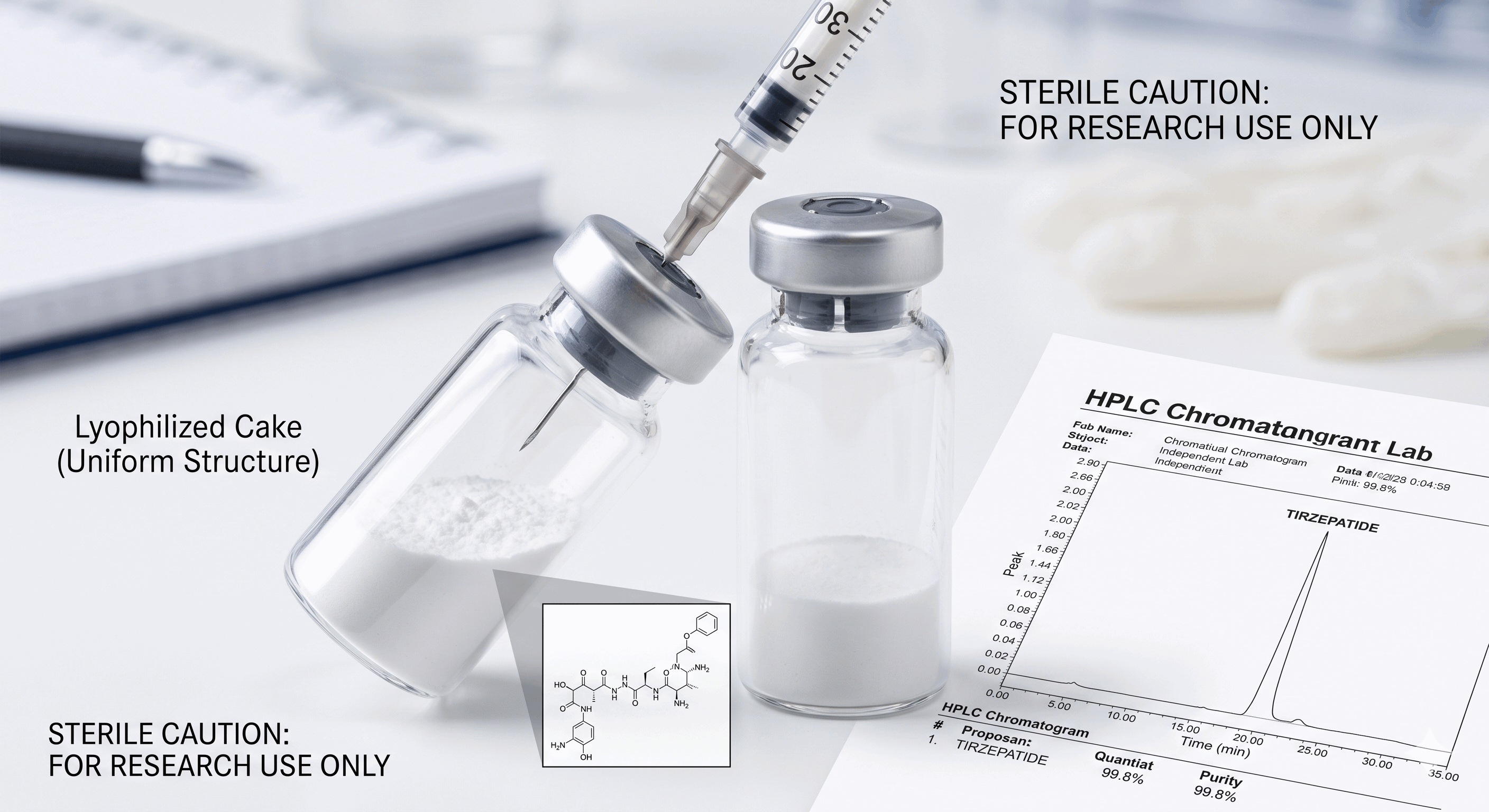
What to Look For: The HPLC graph on the COA should show one massive, clean peak representing Tirzepatide, with virtually no secondary peaks (which indicate impurities).
Purity Threshold: Do not purchase any peptide with an HPLC purity score below 99.0%. Elite peptide vendors frequently hit 99.5% or higher purity levels.
3. Mass Spectrometry (LC-MS) Identity Confirmation
While HPLC tells you how pure a substance is, Liquid Chromatography-Mass Spectrometry (LC-MS) proves what the substance actually is. It measures the molecular weight of the peptide particles to ensure that the chemical sequence perfectly matches the reference standard for Tirzepatide. Without an LC-MS report, a vendor could sell you a 99% pure vial of a completely different, cheaper peptide.
4. Sterility and Endotoxin Screening
Because Tirzepatide is administered via subcutaneous injection, purity goes beyond chemical composition; the vial must be biologically sterile. Reputable suppliers explicitly test for the presence of bacterial endotoxins. Ensure the lab report notes a "Pass" or "Negative" result for microbial contaminants.
5. Proper Cold-Chain and Lyophilization Standards
Pure Tirzepatide should arrive as a dry, white, freeze-dried (lyophilized) powder cake at the bottom of a sealed vacuum vial. Lyophilization keeps the peptide highly stable at room temperature during transit. Once received, the un-reconstituted powder should be stored in a freezer, and once mixed with bacteriostatic water, it must be kept refrigerated at 2°C to 8°C (36°F to 46°F) to prevent degradation.
5. Summary Checklists for Savvy Buyers
To streamline your procurement and protect your health, use this quick checklist when vetting any online peptide source:
[ ] Does the company use independent, ISO/IEC 17025 accredited third-party labs for testing?
[ ] Is there a visible, downloadable COA matching the exact batch number on your product?
[ ] Is the documented HPLC purity strictly 99.0% or greater?
[ ] Does the LC-MS report confirm the correct molecular mass for Tirzepatide?
[ ] Does the product arrive as a crisp, white, lyophilized powder cake rather than a pre-mixed liquid?
By adhering strictly to these safety and purity protocols, you eliminate the guesswork out of sourcing, ensuring that your investment in Tirzepatide yields the safe, potent, and transformative metabolic results this revolutionary peptide is capable of delivering.
Visualizing Peptide Purity Verification
To help you understand what a legitimate, high-purity research peptide looks like under proper laboratory conditions, refer to the reference image below. Note the distinct appearance of the clean, white lyophilized (freeze-dried) powder cake at the bottom of the sterile vacuum vial, which is characteristic of professional manufacturing.