
The pursuit of efficient adipose tissue reduction has shifted dramatically from traditional stimulant-based fat burners to the targeted realm of peptide therapeutics. With the massive clinical success of molecules targeting metabolic pathways, phrases like "peptides for fat loss" have transitioned from niche fitness subcultures into mainstream medical and research conversations.
However, as accessibility increases through compounding pharmacies and online research chemical vendors, the most critical question remains: Are peptides actually safe for fat loss?
Evaluating the safety profile of fat-loss peptides requires looking past marketing hype. It demands a rigorous analysis of how these compounds interact with endocrine pathways, the threshold between therapeutic and toxic dosages, and the potential risks associated with improper administration or unverified sourcing.
1. Categorizing Fat Loss Peptides and Their Safety Mechanisms
"Peptides" is a broad umbrella term. To evaluate safety accurately, we must separate these compounds into distinct classes, as each carries an entirely different physiological impact and risk profile.
GLP-1 and Dual GIP/GLP-1 Receptor Agonists
Compounds like Semaglutide and Tirzepatide mimic natural incretin hormones to delay gastric emptying and signal biological satiety directly to the brain. From a purely clinical perspective, this class has the most robust safety data available, derived from massive, multi-year human clinical trials. Their safety is highly established when used under appropriate medical supervision, though they alter gastrointestinal motility permanently during the duration of use.
Growth Hormone Secretagogues (GHS)
Peptides such as CJC-1295, Ipamorelin, and Tesamorelin work by stimulating the pituitary gland to release endogenous growth hormone (GH), which in turn accelerates lipolysis (the breakdown of fat). The safety mechanism here relies on the body’s natural feedback loops; unlike synthetic Human Growth Hormone (HGH) injections, secretagogues rarely shut down natural GH production completely, reducing the risk of extreme side effects like acromegaly.
Synthetic Lipolytic Fragments
Molecules like AOD9604 are localized fragments of the human growth hormone molecule (specifically the C-terminus region responsible for fat burning). Because it lacks the IGF-1-stimulating portion of the hormone, it does not impact blood sugar levels or induce cellular proliferation, giving it a favorable safety profile in initial clinical evaluations.
2. Research-Backed Safety Dosages: Avoiding the Toxicity Threshold
In endocrinology and peptide research, the dose makes the medicine or the poison. Adverse events spike exponentially when researchers or consumers bypass conservative titration schedules. Below is an overview of established research dosages designed to maximize lipolysis while minimizing systemic risk.
Peptide Category | Prominent Examples | Standard Research Dosage Range | Titration & Administration Protocol |
Incretin Mimetics | Tirzepatide | 2.5 mg to 15.0 mg weekly | Strict Titration Required: Must start at 2.5 mg for 4 weeks to allow pancreatic and gastrointestinal adaptation before stepping up. |
GH Secretagogues | Ipamorelin / CJC-1295 (No DAC) | 100 mcg to 300 mcg daily | Pulsatile Dosing: Typically administered 1–2 times per day on an empty stomach to mimic natural biological GH pulses. |
Lipolytic Fragments | AOD9604 | 300 mcg to 500 mcg daily | Subcutaneous/Oral: Administered consistently in the morning to target fasted fat oxidation without affecting insulin. |
Critical Dosing Insight: Over-dosing growth hormone secretagogues can over-saturate pituitary receptors, leading to severe fluid retention, carpal tunnel symptoms, and undesirable spikes in prolactin or cortisol.
3. Potential Risks and Side Effects: A Transparent Evaluation
While peptides are generally more targeted and predictable than old-school fat loss drugs (like clenbuterol or ephedrine), they are not completely without risk.
Gastrointestinal Disturbances
For GLP-1 based peptides, the most common side effects are gastrointestinal. Rapidly elevating doses can cause severe nausea, intractable vomiting, severe constipation, or diarrhea. In rare instances, severe complications like gastroparesis (stomach paralysis) or acute pancreatitis have occurred, requiring immediate medical intervention.
Insulin Resistance Risks
While some peptides improve insulin sensitivity, improper or prolonged use of lower-quality growth hormone secretagogues can elevate fasting blood glucose levels. If growth hormone levels remain chronically elevated without cycles of rest, the body may develop temporary insulin resistance, mimicking pre-diabetic conditions.
Cardiovascular and Cortisol Fluctuations
Certain non-specific secretagogues (like GHRP-2 or GHRP-6) can inadvertently activate the hunger hormone ghrelin and trigger the systemic release of cortisol and prolactin. Elevated cortisol promotes visceral fat storage and elevates blood pressure, completely counteracting the initial intent of the protocol.
4. The Hidden Risk: Sourcing, Structural Purity, and Immunogenicity
When individuals conclude that a fat-loss peptide was "unsafe" due to an adverse reaction, the true culprit is often not the peptide sequence itself, but a systemic sourcing failure.
Immunogenic Reactions to Impurities
If a peptide vendor distributes a batch that is only 90% pure, the remaining 10% consists of truncated peptide fragments, chemical salts, and residual manufacturing reagents. Injecting these structural anomalies can cause the human immune system to flag the foreign proteins, resulting in severe injection-site rashes, systemic inflammation, or an auto-immune reaction where the body begins attacking its own natural hormones.
Bacterial Endotoxins
Peptides synthesized in sub-standard laboratories without proper sterile cleanrooms can trap bacterial endotoxins during the freeze-drying (lyophilization) process. If introduced into subcutaneous fat tissue, these endotoxins can cause low-grade systemic fevers, extreme fatigue, or localized sterile abscesses that require surgical drainage.
5. Conclusion and Safety Checklist for Researchers
Are peptides safe for fat loss? Yes, provided they are highly pure, correctly dosed, and progressively titrated. They offer a highly precise alternative to metabolic stimulants, but their safety is entirely dependent on the discipline of the protocol and the verification of the compound.
Before initiating any research or application, utilize this safety checklist to mitigate risk completely:
[ ] Incretin Protocol: Does the plan utilize a mandatory 4-week low-dose initiation phase to protect the gastrointestinal tract?
[ ] Glucose Monitoring: Are tools in place to monitor fasting blood glucose levels when researching growth hormone pathways?
[ ] Purity Threshold: Has the specific batch been verified via independent HPLC testing to be $\ge 99.0\%$ pure?
[ ] Sterility Assessment: Does the third-party laboratory Certificate of Analysis (COA) explicitly confirm a "Pass" for endotoxin and microbial screening?
[ ] Sequence Validation: Has the molecular weight been verified through Mass Spectrometry (LC-MS) to ensure it is the correct compound?
Visualizing Clinical Lab Standards for Peptide Research
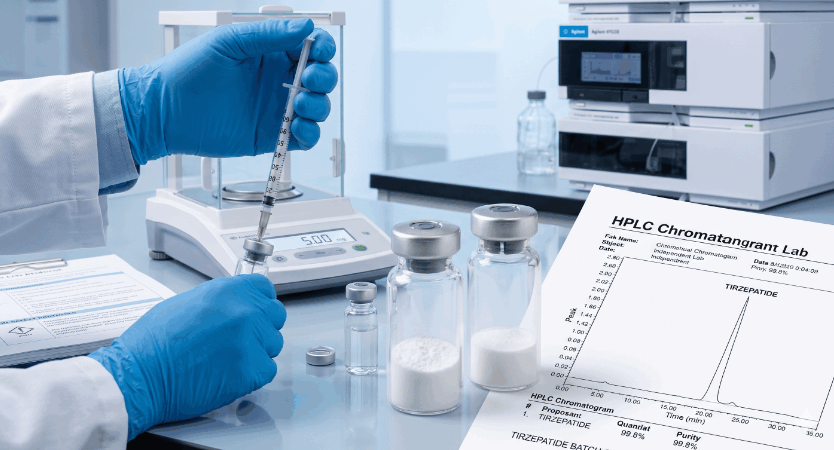
To ensure maximum safety and avoid immunogenic side effects, research peptides must be handled in highly sterile environments and evaluated using advanced analytical chemistry equipment. The reference image below illustrates a standardized laboratory setup where lyophilized compounds are prepared and verified using strict quality control protocols.
Detailed in the image below, you can see a high-purity vial featuring a uniform lyophilized cake alongside standard analytical documentation, reflecting the professional-grade infrastructure required for safe peptide evaluation.